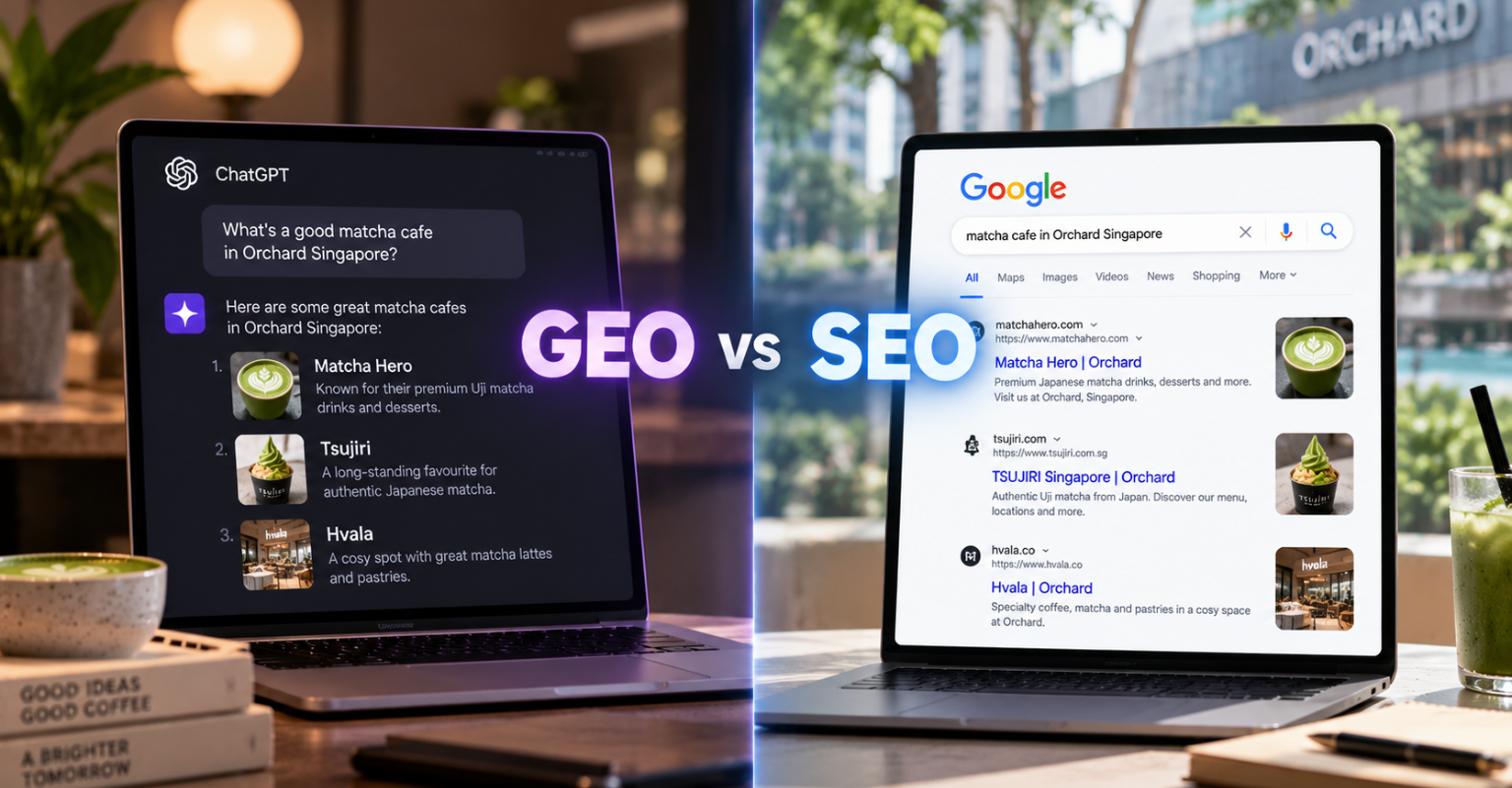
GEO vs SEO comes down to what each one optimizes for. SEO is how you get your website ranking on Google. GEO gets your brand named inside the answer an AI tool gives, before a reader ever clicks a link. Neither replaces the other. Optimize for only one and you give up any influence over the other channel.
Lorem ipsum dolor sit amet, consectetur adipiscing elit. Ut elit tellus, luctus nec ullamcorper mattis, pulvinar dapibus leo.
What Separates GEO From SEO
SEO and GEO optimize for two different moments in a customer’s search. SEO helps your website rank higher in Google’s list of links. GEO helps your business get named inside the answer an AI tool gives instead.
We explain this in our own guide to how AI decides what to recommend. GEO means making your content structured and clear enough for AI systems to retrieve and recommend it. Four signals decide that: Category Clarity, Intent Alignment, Entity Relationships, and Credibility Context.
The shift matters because fewer searches end in a click at all. According to SparkToro’s analysis of Similarweb data, 68.01% of US Google searches in early 2026 ended without a click, up from 60.45% in 2024. According to DataReportal’s mid-2026 global update, reporting GWI survey data, 22.1% of online adults use an AI tool when researching a purchase. Search engines still get 45.8% of that research, more than twice the AI share, though that’s down from 51.3% in mid-2024.
GEO vs SEO Side by Side
GEO and SEO differ on what they optimize for, what signals they read, and how fast they move. Seeing the two side by side shows why one can’t stand in for the other.
SEO GEO
Optimizes for – Ranking position on Google
Primary signal – Backlinks, technical crawlability, keyword relevance
Typical timeline – A few hours to several months, per Google’s own guidance
What a win looks like – A top-ranking position and a click
Where the win shows up – A ranked link
in the results list
Optimized for – Getting named inside an AI-generated answer
Primary signal – Category Clarity, Intent Alignment, Entity Relationships, Credibility Context
Typical timeline – No ranking position to climb, though what an assistant retrieves still depends partly on what already ranks
What a win looks like – A citation or recommendation, no click required
Where the win shows up – A named mention inside the answer, including Google’s own AI Overviews
GEO vs SEO: How Fast Each One Moves
SEO and GEO move on different clocks because they read different things. Google ranks a page on signals that accumulate: crawling, indexing, links, and history. According to Google’s own SEO Starter Guide, some changes might take effect in a few hours, others could take several months.
An AI assistant has no equivalent history to work through. It reads what it can retrieve when the question is asked, not a ranking built up over months.
GEO still doesn’t stand alone. In our view, AI answers lean on content that already performs well in search, so a weak SEO foundation limits what GEO can reach.
An Example of Each One Winning
The same question can land in either place, depending on what a customer opens. Someone comparing CRM tools in Google still wants to see several options before deciding. They click through to a page, so SEO decides whether that page is yours.
Someone asking an assistant “best aesthetic clinic in Singapore for natural-looking results” gets one or two names back, with no page of links at all. GEO decides whether yours is one of them. It’s one of the example questions in our own FAQ
Why Your Business Needs Both
SEO and GEO cover different parts of the same buyer journey. Most of that journey still starts in Google, and some of it now ends with someone asking an assistant to narrow the shortlist. Treating SEO and GEO as competing budgets costs you visibility in one channel to fund the other.
We sell GEO and SEO as two separate services, because they solve different halves of the same problem. Your website still needs to rank. Your brand still needs to be the one an AI tool names when a customer asks it to choose.
Building a Plan for Both
Getting GEO and SEO working together starts with the same source material. Content needs to be clear, factual, and well structured. It also needs Category Clarity and Entity Relationships: language that names exactly what your business does, who it serves, and where it operates.
At El Brand we run a free AI visibility assessment that shows how AI tools currently describe and recommend your brand. Talk to us if you want one.
FAQs
What does GEO stand for?
GEO stands for Generative Engine Optimization. It’s the practice of making your content structured and clear enough for AI systems to retrieve and recommend it. The aim is for tools like ChatGPT, Gemini, and Perplexity to cite or recommend your brand inside an answer.
Is GEO replacing SEO?
No, GEO and SEO answer different questions. SEO decides whether Google ranks your site, and GEO decides whether an AI tool names your brand at all.
How long does it take to see results from GEO compared to SEO?
SEO moves on Google’s own timeline. According to Google’s own SEO Starter Guide, some changes might take effect in a few hours, others could take several months. GEO doesn’t run on that same ranking cycle, because an assistant reads what it can retrieve at the time of the question.
Does GEO require changing my website?
Not a full rebuild. Most of the work is restructuring content you already have so an AI system can read it. It also means making sure your brand is described the same way everywhere else it appears, with a direct answer and clear category language.
Where to Start
Check where you stand before changing anything. The free AI visibility assessment shows how AI tools describe your brand today. That answer decides whether GEO, SEO, or both need the next move. Talk to us to get started.