Who talks about you when you’re not in the room?
A client mentions your name to someone looking for help. A former colleague makes an introduction. A customer tells a friend where to go. Someone searches for a recommendation online. Increasingly, an AI platform answers the question before a person does.
Different routes. Same underlying question.


What makes someone confident enough to recommend you?
Being seen helps. But visibility only gets your name into the conversation. Trust determines what happens next.
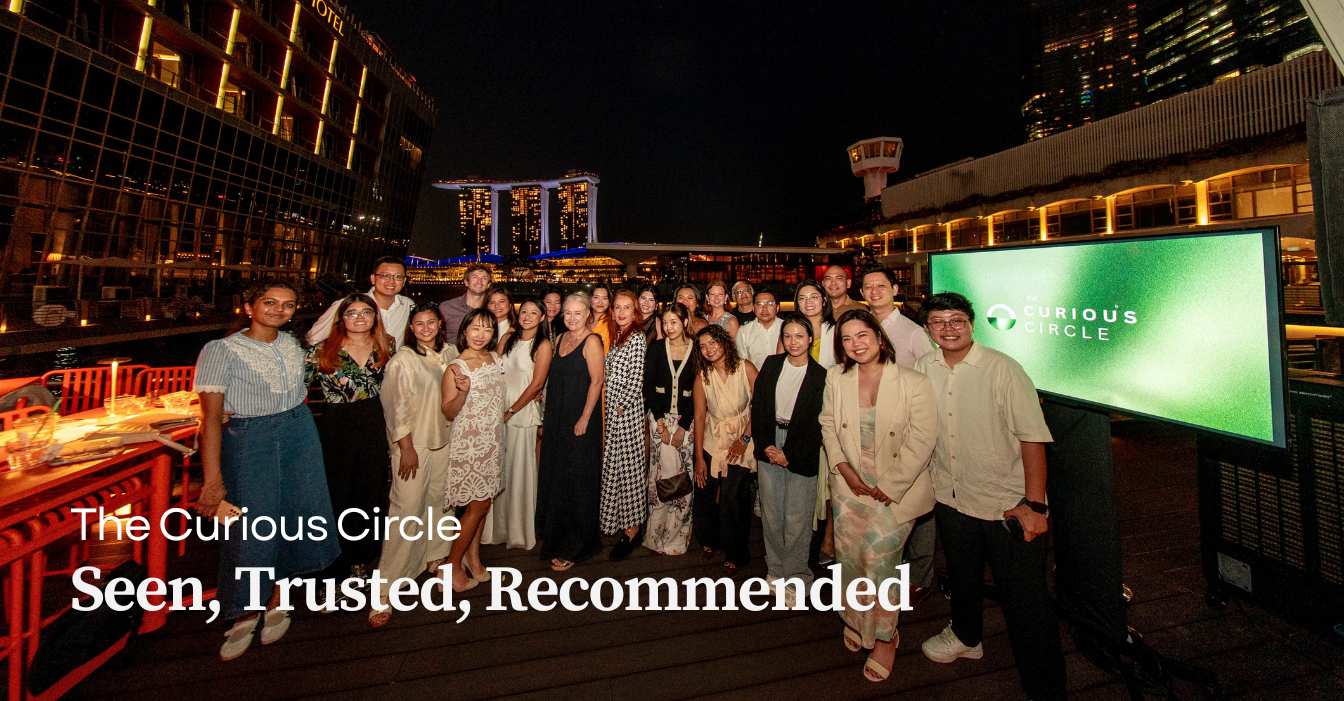
This was the thinking behind The Curious Circle Series 2: Seen, Trusted, Recommended, hosted by El Brand on 21 August 2026 at Chimi’s Especial, Customs House in Singapore.
We brought together founders, business leaders, creatives, and professionals for an evening built around one idea: how trust is formed, carried, and translated into recommendations today.
Welcoming everyone to the Circle, Paula Andrade, founder of El Brand and The Curious Circle, brought the evening back to what sits at the heart of the initiative: curiosity. Her invitation was simple. Stay curious about the people in the room, the ideas being shared, and perhaps most importantly, what might come from those conversations after the evening ends.
Guiding those conversations was Nazreen Coupland, Assistant Manager at the SMU Institute of Innovation & Entrepreneurship, who hosted the evening. With four speakers approaching trust from different worlds, Nazreen helped connect the threads naturally, giving each topic room to stand on its own while drawing out the ideas they shared.
Reputation and bias. Listening and consistency. Building credibility across markets. And the growing role of AI in deciding which businesses surface when people ask for recommendations.
What emerged was less about getting more attention and more about what happens after someone notices you.
Because being known is one thing.
Being trusted enough for someone to put your name forward is another.

AI does not know your brand the way you think it does
Pradnya Nikam of OmniGro AI brought a newer layer to the conversation: as people increasingly use AI to search, compare, and ask for recommendations, how well does AI understand what we put online?
Her talk looked at the gap between publishing content and creating information AI can interpret.
Brands publish constantly. Websites, social posts, videos, campaigns, interviews, articles, and visual content all contribute to a digital presence. From our perspective, the message might feel clear. We know the context behind a campaign. We understand what a video is trying to say. We know why a piece of content matters to our business.
AI does not automatically share that context.
Pradnya explained how businesses often put valuable information online without giving AI enough signals to understand what the content means, who it relates to, or why it matters. This matters more as AI systems increasingly sit between a person’s question and the businesses they eventually find.
One of several examples she shared made the problem easy to picture. A brand might invest heavily in a beautifully produced video. The visuals tell a great story to a human viewer, but with little supporting text, captions, transcripts, titles, or descriptions, much of its meaning becomes harder for AI to interpret.
The point was not to start creating content for machines instead of people. It was to become more deliberate about making the knowledge behind our content understandable to both.
Being online does not mean being understood.
For brands, visibility is no longer only about appearing in the right places. The information surrounding your brand needs enough clarity, context, and supporting evidence for people and AI systems to understand what you do, what you know, and why your name belongs in a recommendation.

What happens when people know nothing about you?
Atty. Agnes Botor of Adan Botor and Associates Law Office approached trust through reputation, leadership, and something we rarely acknowledge: the assumptions people make before they have enough information about us.
One line from her talk stayed with us:
“No one knows how smart you are. No one knows what you don’t.”
We often think trust comes from what people know about us. Our experience, our work, our reputation, and the people willing to speak for us.
But what happens when they know nothing yet?
That space rarely stays empty. People form impressions. Bias and assumptions begin filling the gaps before someone fully understands what you know or what you are capable of.
Then there is the other side of trust: stepping into a reputation built before you.
At Adan Botor and Associates Law Office, Agnes is helping carry forward a legal practice with an established name, history, and relationships, while also thinking about how the firm evolves, reaches new clients, and responds to a changing business environment.
A respected name brings credibility, but it also brings expectations. The work is not only about preserving what came before. It is about continuing to give people reasons to trust what the name represents today.
A reputation might open the door. What you do once you walk through it is what keeps that trust moving forward.

Trust Has No Passport
For Ruth Lockwood of Santa Fe Relocation, trust has travelled with her.
Having lived and worked across different countries, and having spent years helping individuals and families through international moves, Ruth spoke about trust from experience. Her talk, “Trust Has No Passport,” captured what happens when someone leaves behind everything familiar and has to begin again somewhere new.
Suddenly, even ordinary things become questions.
Where is the wet market? How do I get to the train station? Where do I buy what my family needs?
Things that once required no thought now need to be learned again.
Ruth brought the audience into that feeling. Moving countries is not simply about transporting belongings from one address to another. There is uncertainty, vulnerability, excitement, and the quiet discomfort of no longer knowing how everyday life works.

In those moments, trust carries a different weight.
Her emphasis on really listening felt especially important. When someone is trying to find their footing in an unfamiliar place, listening means understanding what they need beyond the obvious transaction. It is how respect is earned and relationships begin to form.
Then comes consistency. Showing up once matters. Showing up with the same care, attention, and reliability over time is what turns an interaction into trust.
Ruth’s stories made the title of her talk feel less like a statement and more like something she had seen proven across borders.
Trust has no passport because wherever people go, they still need to feel heard, understood, and able to rely on someone.

Starting Somewhere New
For Tam Nguyen, starting somewhere new meant making the decision to bet on herself before finding another job.
A serial entrepreneur who has started four businesses and operated two in the logistics solutions space, Tam already had ten years of running businesses behind her when she started G.O.L Solution, Goods Online Solution. Today, the company helps e-commerce brands prepare the paperwork, compliance, and market-entry requirements needed to expand into regions such as Southeast Asia and North America.
In her first year, Tam faced a question familiar to anyone entering a new space:
“How do I build trust that transcends borders?”
Her first move was creating a digital footprint. She focused on a website and LinkedIn, where her potential clients already spent time.
Her LinkedIn content eventually reached one million views.
The interesting part was what happened after.
Those views did not translate into new leads. The clients who eventually signed had often found her website first, then checked her LinkedIn presence for credibility before making a decision.
That gave her a clearer understanding of the role the platform played:
“LinkedIn isn’t a discovery channel. It’s a trust-building tool.”
Tam approached her content through a lean startup mindset. Measure. Test. Track. Learn from the results, then improve. Rather than doing more for the sake of visibility, she became clearer about what she wanted each channel to achieve.
The same thinking carries into her work with businesses starting somewhere new.
For a brand entering another country, trust also depends on what happens behind the scenes. Does the product fit the local market? Are the right licences and paperwork in place? Does the business understand local compliance?
Through G.O.L Solution’s Southeast Asia compliance work, brands are able to use Singapore as a fulfilment hub while preparing to enter new markets and staying compliant.
Her story connected personal visibility with something much bigger. Starting somewhere new, whether as a founder or as a brand entering another country, asks you to establish credibility where people do not know you yet.
And as Tam put it:
“Trust is built by consistency across channels and markets.”

(From Left: Paula Andrade, Founder of El Brand and The Curious Circle, Naz Coupland from SMU, Tam Nguyen Founder of G.O.L Solution, Monie from G.O.L Solution, Rebecca Bisset, Founder of Expat Living, Ruth Lockwood Head of Strategic Sales SEA Santa Fe Relocation, Janakan Arulkumarasan, Co-Founder and CEO of Leaders.org)

(From Left: Tam Nguyen and Founder Monie of G.O.L Solution, Rebecca Bisset, Founder & Chief Editor of Expat Living, Jerika Cleto, Senior Business Developer of SimCorp, Ruth Lockwood Head of Strategic Sales SEA Santa Fe Relocation, Janakan Arulkumarasan, Co-Founder and CEO of Leaders.org)

(From Left: Yoko Hanawa Co-Founder & Managing Director Excort Pte Ltd and Mai Soori from Mastercard Asia)

(From Left: Pradnya Nikam, Founder of Omnigro AI, Naz Coupland from SMU, Ruth Lockwood Head of Strategic Sales SEA Santa Fe Relocation, Jordon and Griffin of KPLASS Singapore, Himanshu of AV8 Media, Tam Nguyen Founder of G.O.L Solution, Monie from G.O.L Solution, Louise Hawley, Managing Director of NielsenIQ, Rebecca Bisset, Founder of Expat Living)

(Margarita Lacson, President of PhilCham of Commerce in Singapore with Naz Coupland of SMU)


(Christine Pearl Reyes Senior eCommerce Executive of Epitex and Badz)

(From Left: Pradnya Nikam of OmniGro AI, Ruth Lockwood of Santa Fe Relocation, Agnes Botor of Adan Botor & Associates Law, Paula Andrade of El Brand and The Curious Circle, and Tam Nguyen of G.O.L Solution)

(From Left: Muhammad Taqiyuddin, CEO of Krafted Concept and Himanshu Sha, Director of AV8 Media)

(Dan Sain and Atty. Agnes Botor-Sain)

(Nadia, Director of Gailbook)

(Catherine Reyes, Business Development Manager of The Work Boulevard with husband Elmer Reyes Jr)


What happens after being seen
Across all four conversations, one thing became clearer: visibility is only the beginning.
There is no single moment when a person or brand suddenly becomes trusted. It is built through the things we say, the work we put behind them, and the experiences people carry with them afterward.
At El Brand, this is also why we created The Curious Circle. As a marketing agency, much of our work sits at the intersection of how brands are seen, understood, experienced, and remembered. The Circle gives us another way to explore those questions, not only through marketing, but through the lived experiences of people building businesses, leading teams, crossing markets, and shaping communities.
Series 2 started with a question: What makes someone confident enough to recommend you when you’re not in the room?
Perhaps the answer is not one big thing.
It is everything people find, hear, experience, and remember about you when you are no longer there to explain yourself.