Boutique hotel branding builds guest loyalty through recognition, not points. A small hospitality brand can’t out-discount a chain’s rewards program, but it doesn’t need to. Consistent identity, sensory detail, and a loyalty structure sized to one property can make a guest feel remembered from the moment they walk in.
What Makes Boutique Hotel Branding Different From Chain Loyalty Programs
Chain loyalty programs work because of scale: a point earned at one property can be redeemed at hundreds of others. That’s the incentive for a guest to keep coming back to the brand, rather than to one specific building. Boutique hotel branding runs on the opposite logic. A small hospitality brand has one property, one story, and a direct relationship with every guest who walks through the door.
According to CBRE, loyalty membership across five major chains, Choice, Hilton, Hyatt, Marriott, and Wyndham, grew 14.5% in 2024 to more than 675 million members. Members accounted for 52.8% of those chains’ occupied rooms in 2024. That scale is what makes a points ledger worth maintaining. A single boutique property will rarely accumulate enough repeat stays to make one meaningful to a guest.
So the loyalty mechanism has to work differently. A guest needs to feel recognized by name, in a space with one clear identity. Chains build whole systems so a front desk can tell who is standing there. In a 2022 YouGov survey for SevenRooms, 40% of business travelers said being recognized for loyalty status at check-in made them more likely to rebook. A boutique property gets there by a shorter route: the person at the desk already knows the guest, no tier required.
Boutique Hotel Branding Elements That Drive Repeat Bookings
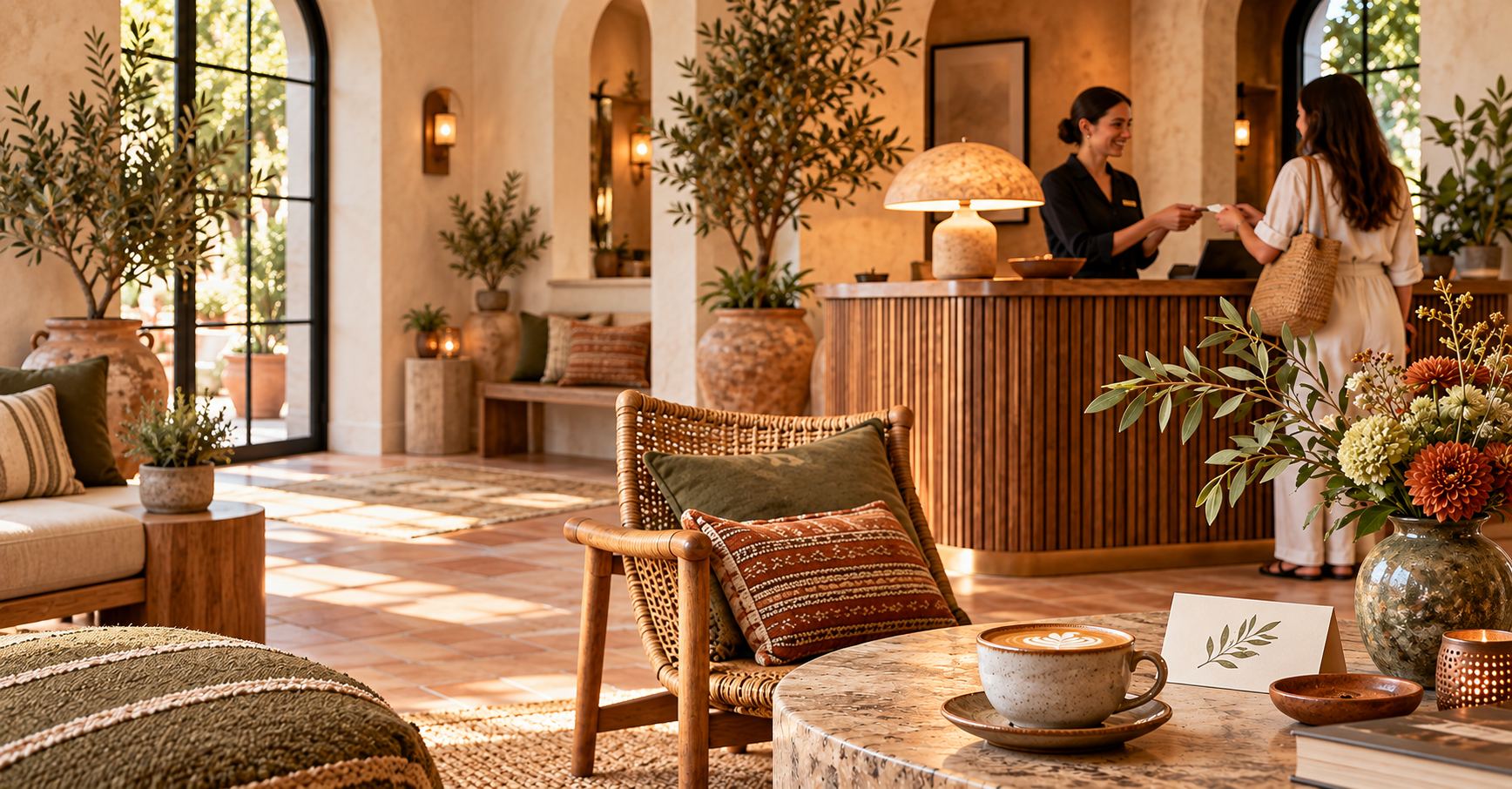
The elements that bring a guest back are ones a boutique hotel already has, without needing a system to produce them. A name staff remembers, a signature detail unique to the property, and a loyalty mechanic simple enough to describe in one sentence, all do it.
One of our published case studies shows this directly. Bistro Roberto is the in-house restobar at Villa Caceres Hotel in Naga City. Before El Brand existed, our founder, Paula Andrade, led its rebrand while working as the hotel’s Sales and Marketing Manager. The bar was perceived as a spot mainly for an older crowd. The rebrand gave it a new logo and a modern, inclusive identity for families, working professionals, nightlife enthusiasts, and hotel guests. It also added a Bistro360 membership card. According to our Bistro Roberto case study, that card “fostered brand loyalty and repeat patronage, ensuring sustained business growth.”
Three elements do the work:
- A visual identity built for the local market.
- A named loyalty mechanic, a card, a perk, a standing note on a guest’s preferences, simple enough that staff apply it without a script.
- A story tied to the place itself, so the guest remembers this property specifically.
Sensory and Experience Branding in Practice
Sensory and experience details are a further lever, beyond a named loyalty mechanic. A consistent scent, a tone of voice repeated across every message, and a physical space matched to a specific feeling all create memory. A discount code rarely does.
According to Harvard Medicine Magazine, Harvard Medical School neurobiologist Sandeep Robert Datta explains that smell signals travel directly to the brain’s memory and emotion centers. Other senses go through a processing step first; smell bypasses it. Odor-evoked memories also tend to be more emotional than memories triggered by other senses, and more likely to reach further back.
We saw the identity side of this lever at Baretouch, when the spa relocated to a smaller space in Naga City. The move risked reading as a step down rather than a refinement. According to our Baretouch case study, we designed a minimalist logo and calming palette to reflect the spa’s quiet luxury. We also set a warm, grounded tone of voice to match. We laid the foundation for a membership card with partner rewards, so the spa’s value would extend past individual treatments.
Build the identity first. A membership card launched into a brand a guest can’t yet describe reads as just another discount.
Recognition-Based Loyalty vs Points-Based Programs
A points-based program rewards volume. A recognition-based program rewards being known. Boutique hotels rarely have the redemption network to compete on the first measure. But they can outperform a chain on the second: knowing an individual guest by name and preference.
| Comparison | Points-based program (chain) | Recognition-based program (boutique) |
|---|---|---|
| Redemption | Across hundreds of properties | Within one property, through an ongoing relationship |
| What’s tracked | Nights stayed, points earned, membership tier | Name, preferences, special occasions |
| Guest feeling | “I’m closer to my next tier.” | “They remember me.” |
| What’s needed to build | A points platform spanning multiple properties | Consistent staff habits, a guest log, a personal card or thoughtful perk |
A boutique hotel that tries to copy the first model is competing without a redemption network wide enough to make it worth a guest’s effort. The second model costs less to run and works precisely because the hotel is small enough to remember its guests.
FAQs
Do boutique hotels need a formal loyalty program?
Boutique hotels don’t need a chain-style points-and-tiers system. They need a repeatable way to recognize a returning guest: a membership card, a standing preference note, or a perk staff apply without being asked.
What makes boutique hotel branding different from a big chain’s brand?
A boutique hotel’s brand is tied to one physical place and one story, while a chain’s brand has to work identically across hundreds of properties. That difference is what lets a boutique hotel use its own identity as the reason a guest returns.
How much does a signature scent or sensory detail actually matter for guest loyalty?
It matters because, according to Harvard Medicine Magazine, scent reaches memory through a more direct brain pathway than sight or sound. Smell signals route directly to the brain’s memory and emotion centers, while other senses pass through an extra processing step first. Odor-evoked memories also tend to be more emotional than memories triggered by other senses. That’s why a consistent signature scent can make a stay memorable long after checkout.
Can a small hospitality brand build loyalty without discounting?
Yes. A recognizable identity paired with a rewards mechanic gives a guest a reason to come back on purpose. Bistro Roberto’s Bistro360 card is a live example: a loyalty mechanic that sits inside a rebuilt identity. According to the case study, that combination helped foster repeat patronage.
Building Loyalty That Fits Your Scale
This works because your hotel is small enough to make it personal. Start with the one piece of your brand a guest already notices. Build a simple loyalty mechanic around it. Talk to us about your hospitality brand if you want help doing that.