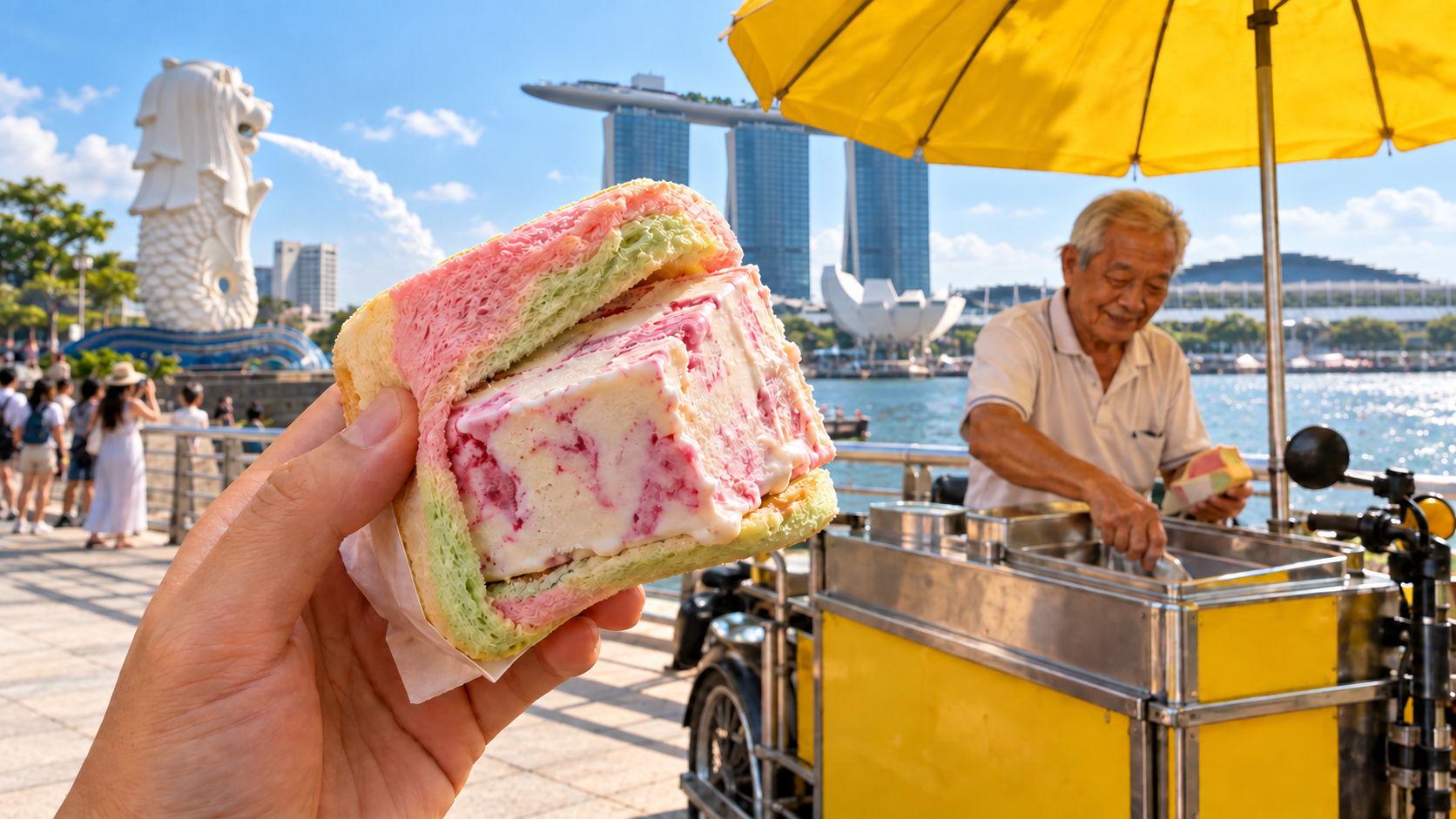
A yellow parasol. A freezer lid lifting. The choice between wafers and rainbow bread.
For many people who grew up in Singapore, the ice cream uncle needs little introduction. A few coins bought something cold on a hot afternoon, followed by a race against melting ice cream.
Magnolia became part of those moments. Behind the familiar name sits a business history involving Scottish printers, international partnerships, and decisions about how to reach customers.
For anyone building a brand, there is plenty to learn from both sides of the cart.
F&N’s history began with two Scottish printers
In 1883, John Fraser and David Chalmers Neave established the Singapore and Straits Aerated Water Company alongside their printing business. They began producing carbonated soft drinks. The venture eventually grew into Fraser and Neave, better known as F&N. F&N’s heritage timeline traces this move from printing into beverages. www.fraserandneave.com
The founders entered one business. Successive generations of the company expanded into others, using partnerships, franchises, acquisitions, and products of their own.
Those distinctions matter. A good business story deserves more than a tidy claim about two men building everything themselves.
Tiger Beer grew from a partnership
In 1931, F&N formed Malayan Breweries with Heineken. Tiger Beer launched the following year. The partnership combined resources and brewing expertise to establish a beer business in the region.
F&N eventually sold its entire interest in Asia Pacific Breweries in 2012. Tiger Beer belongs to its business history rather than its current portfolio. www.fraserandneave.com
Coca-Cola arrived through a bottling franchise
In 1936, F&N received the Coca-Cola bottling franchise for Singapore and Malaysia. Working with an international beverage brand gave F&N another route to growth.
The arrangement involved local production and market access, a larger responsibility than simply reselling bottles. The licensing partnership later ended, as F&N explains in its investor FAQ. www.fraserandneave.com
Magnolia had a history before F&N
Magnolia’s Singapore story includes Cold Storage. Its Magnolia Milk Bar appears in the National Library Board’s account of shopping and social life in the 1960s.
F&N’s timeline records its acquisition of Cold Storage Holdings’ Singapore dairy operations in 1990. Magnolia later became part of the group’s dairy and ice cream portfolio. biblioasia.nlb.gov.sg
The brand strategy lesson: choose how to grow
F&N’s history offers several routes to building a business. Develop a product. Find a partner with complementary expertise. Secure a franchise. Acquire an established operation.
The company also launched its own brands, including 100PLUS in 1983. Its growth story therefore includes both product development and collaboration. www.fraserandneave.com
For business owners, the useful question is practical: where does your company add the most value?
A manufacturer understands production. A distributor knows buyers and channels. A local partner understands habits, relationships, and expectations in a particular market. Strong partnerships give each party a clear role.
This matters in cross-border marketing. A product with demand in one country still needs a convincing reason to earn attention in another. Pricing, packaging, messaging, and the place where customers encounter the brand all influence that decision.
El Brand explores this further in why cultural nuance matters in marketing across Singapore and the Philippines. Familiarity in one market does not automatically travel with the product.
F&N reported S$2.323 billion in revenue for the financial year ended 30 September 2025, compared with S$2.162 billion in FY2024. These group financial figures reflect a business built over generations, across multiple categories and markets. They also show why reducing its history to a single distribution strategy misses much of the work involved. www.fraserandneave.com
The ice cream uncle made the brand personal
Corporate histories record acquisitions and launch dates. Customers remember the afternoon.
The cart stood somewhere familiar. The vendor cut the ice cream, folded the bread, and handed over a small treat before the journey home.
From a marketing perspective, the cart brought several elements together: a recognisable product, a convenient location, a simple purchase, and a person delivering the experience. Repeat those encounters over time, and a brand earns a place in someone’s everyday life.
That is a useful reminder for F&B and hospitality businesses. Brand building happens during ordinary interactions: a staff member remembering an order, a product being easy to find, or a small purchase arriving exactly when someone wants it.
Those experiences give people something specific to recall and recommend. We explored the relationship between visibility, experience, and building trust and brand reputation at The Curious Circle.
What happens when the familiar cart disappears?
The streetside ice cream trade also has a human reality beyond the nostalgia.
In a February 2024 parliamentary reply, Singapore’s Ministry of Sustainability and the Environment reported 11 active ice cream licences under the Street Hawking Scheme as of January 2024. These licences belong to their individual holders and are non-transferable.
The figure refers specifically to licences under that scheme. The reply does not state a blanket end to licence renewals. www.mse.gov.sg
For brands, the larger question concerns what customers value about a familiar experience. Keeping the product available preserves one part. The person, place, and ritual contribute something else.
This is the subject behind The Curious Circle Series 3: We Are All in the Memory Industry: how businesses shape experiences people carry with them.
What business owners should take from Magnolia’s story
Look closely at where your customers meet your brand. Is the product easy to buy? Does the experience give people a reason to return? Do your partners strengthen the relationship you want with customers?
Then examine your messaging. Explain your value clearly enough for someone encountering your business for the first time, especially in a new market.
At El Brand, a cross-border marketing agency in Singapore, we help businesses strengthen their positioning, communicate across markets, and improve their visibility through branding, content, SEO, and AI visibility.
If your business is preparing to reach a new audience, book a conversation with El Brand about your brand positioning and marketing priorities.
Sometimes the experience people remember starts with something as small as ice cream in rainbow bread.