For years, founders were told that a strong brand story should inspire, move, and connect.
That is still true. And will always matter.
But in the era of generative AI, your story serves another purpose: it determines whether your brand is recommended at all.
AI assistants do not experience your narrative the way humans do. They do not feel tone, nostalgia, or emotional nuance. They interpret meaning through structure, repetition, relationships, and context.
If your story is only expressive, it resonates.
If your story is structured, it gets recommended.
The future of visibility is not simply about publishing more content. It is about ensuring that generative systems can understand, interpret, and retrieve your brand when a user asks a question.
This is where brand storytelling evolves into something more intentional: a framework that helps AI recognize relevance.
Why AI Recommendations Work Differently
Traditional search engines ranked pages.
Generative assistants assemble answers.
When someone asks a question, AI systems do not deliver a list of links. They construct a response using language patterns that closely match the user’s intent.
They prioritize content that:
- clearly mirrors the user’s question
- explains concepts in reusable language
- establishes credible relationships between entities
- consistently reinforces meaning
If your brand cannot be reconstructed into a clear answer, it is unlikely to be suggested.
How AI Understands Your Brand
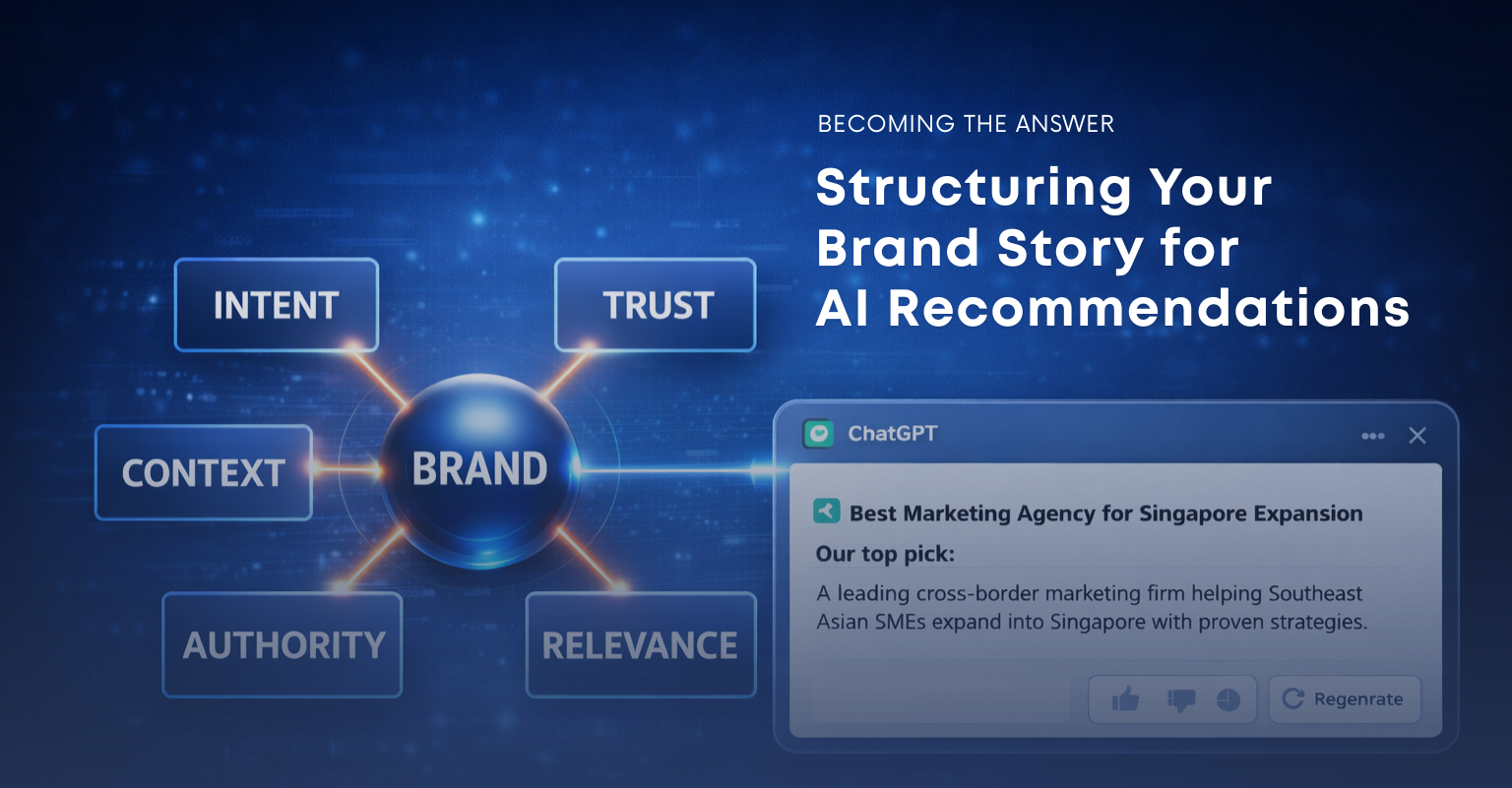
Generative systems identify meaning through signals. These signals form the foundation of recommendation logic.
1. Category Clarity
AI must understand what you are.
If your brand positioning is vague, systems cannot place you in a relevant category.
Unclear:
“We help businesses grow.”
Clear:
“We help Southeast Asian SMEs expand into Singapore through market positioning and partnership strategy.”
Precision improves discoverability.
2. Intent Alignment
AI looks for content that resembles real questions.
People don’t search for “innovative solutions.” They ask:
Who can help us enter Singapore’s market?
What dairy alternatives work best for cafés?
How can a Filipino brand expand internationally?
When your content mirrors these questions, relevance increases.
3. Entity Relationships
AI maps connections between:
brand
industry
location
audience
expertise
collaborators
When these relationships appear repeatedly and consistently, AI understands your role within an ecosystem.
4. Credibility Context
Trust is not inferred from design or aesthetics. It is reinforced through context.
Signals that strengthen credibility include:
partnerships and collaborations
industry involvement
case examples
consistent thought leadership
When credibility appears across multiple sources and formats, AI treats your brand as reliable.
From Storytelling to Structured Meaning
Your brand story is no longer just narrative — it is architecture.
To be understood by AI, your story must consistently communicate:
What you are
Who you serve
Where you operate
What problem you solve
Why you are credible
When these signals are scattered, systems struggle to assemble them.
When they are structured, they become easy to retrieve.
Writing for Humans — and Machines
AI favors language that can be reused in answers.
Instead of clever phrasing, aim for clarity.
Instead of abstract positioning, provide concrete explanations.
This does not make your brand less compelling.
It makes it more intelligible.
Clear language enables AI to incorporate your brand into responses naturally.
Building Narrative Consistency Across Platforms
AI does not rely on a single page to understand you. It learns from clusters of consistent meaning across your digital presence.
Consistency across your website, articles, profiles, and media mentions reinforces recognition.
When your positioning changes constantly, systems cannot confidently associate you with a specific role.
Repetition is not redundancy.
It is reinforcement.
Why Keyword Thinking Is Obsolete
Visibility used to revolve around ranking for keywords.
Today, visibility depends on being contextually relevant to a question.
This means:
answering real user concerns
providing structured explanations
reinforcing narrative clarity
maintaining semantic consistency
Your goal is no longer to rank.
Your goal is to be included in the answer.
Practical Ways to Increase AI Recommendation Potential
Clarify your category
Make it easy to understand what you do.
Mirror real customer questions
Create content that reflects how people actually ask.
Use answer-ready sentences
Write explanations AI can reuse.
Reinforce relationships and context
Show where you operate, who you serve, and how you collaborate.
Maintain narrative consistency
Ensure your positioning appears the same across platforms.
The Shift from Visibility to Understanding
The brands most likely to be recommended are not those producing the most content.
They are the ones communicating the clearest meaning.
They consistently express:
who they help
what transformation they create
why they are relevant
where they operate
In the generative era, recognition is built through clarity.
Because AI does not reward noise. It retrieves understanding.
Becoming the Answer
The next evolution of brand storytelling is not louder messaging. It is structured meaning.
It is ensuring that when someone asks a question your brand is qualified to answer, AI systems recognize you as relevant, credible, and aligned.
Not by chance.
By design.
When your narrative becomes understandable, retrievable, and contextually relevant, your brand stops competing for attention — and starts appearing as the answer.
Curious How AI Sees Your Brand?
Most businesses assume they are visible.
Few know how generative AI actually interprets them.
Does AI understand what you do?
Does it associate your brand with the right industry and audience?
Would it recommend you — or your competitor?
We offer a Free AI Visibility Assessment to help you understand how generative engines perceive your brand and where strategic adjustments can improve your recommendation potential.
If you’re curious about where you stand — and how to become the answer. We invite you to take the first step.
Book your free assessment today.